The Mux VS Code extension allows you to easily pair with Mux during development. Our extension works with VS Code and Cursor.
It’s especially useful for completing the “last mile” of a task or establishing the initial architecture.
Overview
The extension has a small initial surface area: a command to open a workspace and a Secondary Sidebar Chat view (Preview).
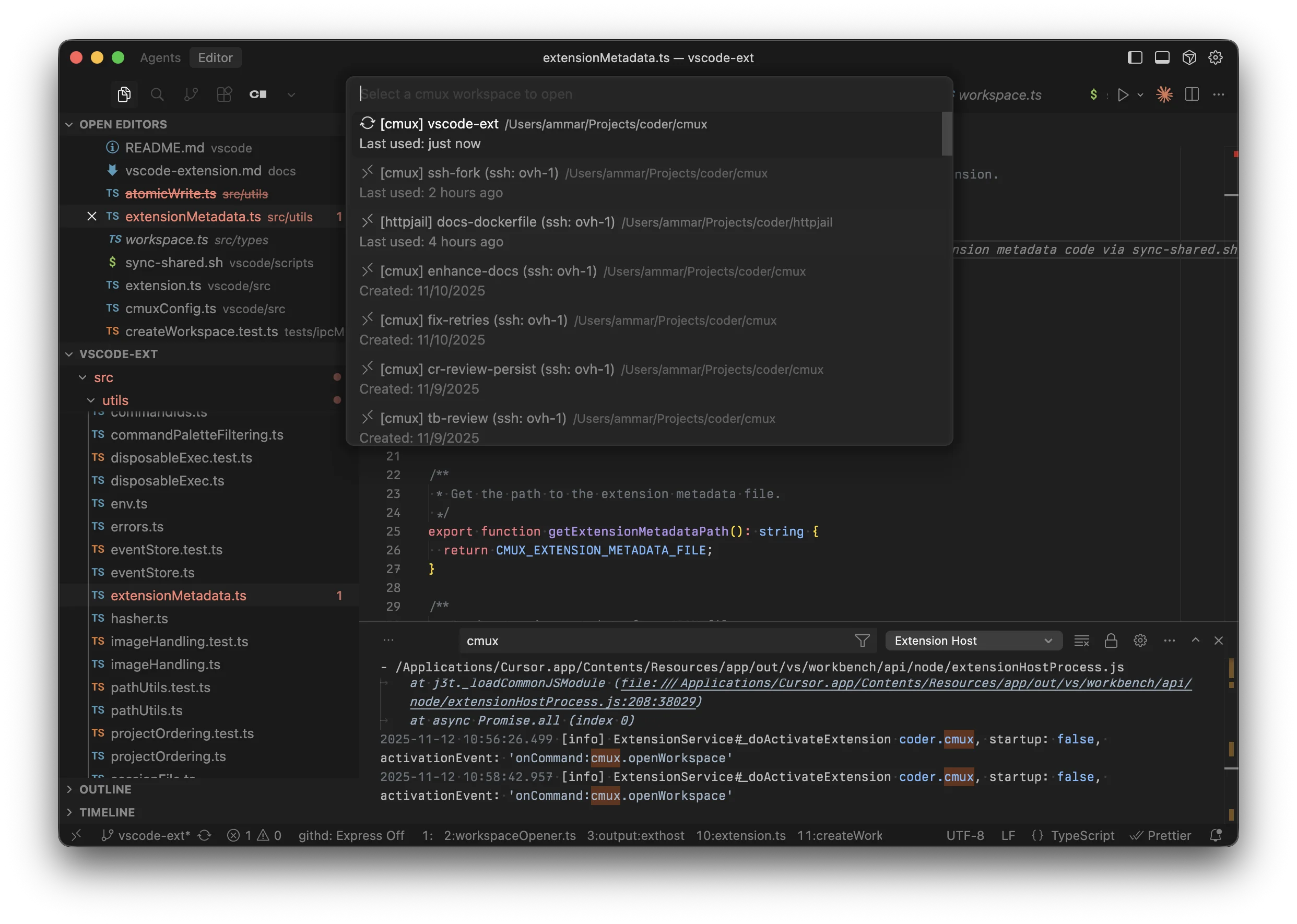
- Press
Cmd+Shift+P (or Ctrl+Shift+P on Windows/Linux)
- Type “mux: Open Workspace”
- Optional: Set a custom keybinding in the Command Palette settings
- Select your workspace
- It opens in a new editor window
The extension works with both local and SSH workspaces.
The Secondary Sidebar Chat view is a preview feature and is under active development. Expect bugs
and breaking changes.
mux container: Chat (Preview).
- Open Chat (Preview)
- Select a Mux workspace from the picker
- Chat normally; use the pencil icon to open the workspace in a new window
To send messages, Mux must be connected in server/API mode.
If you hit issues, please report them on the Mux GitHub issues page.
Installation
Download
Download the latest .vsix file from the GitHub releases page.
Install
Command line:
# For VS Code
code --install-extension mux-*.vsix

# For Cursor
cursor --install-extension mux-*.vsix
- Open Command Palette (
Cmd+Shift+P)
- Type “Extensions: Install from VSIX…”
- Select the downloaded file
Workspace Types
The extension displays workspaces differently based on their type:
- Local:
📁 [project-name] workspace-name
- SSH:
🔗 [project-name] workspace-name (ssh: hostname)
SSH Workspaces
Requirements
For SSH workspaces to work, you need:
- Remote-SSH Extension installed
- VS Code:
ms-vscode-remote.remote-ssh
- Cursor:
anysphere.remote-ssh
- The extension automatically detects which one you have
- SSH host configured in
~/.ssh/config or in the Remote-SSH extension
Setup SSH Host
If you haven’t configured the SSH host yet:
-
Open
~/.ssh/config and add:
Host myserver
  HostName 192.168.1.100
  User username
  IdentityFile ~/.ssh/id_rsa
-
Or use VS Code’s Remote-SSH command:
Cmd+Shift+P → “Remote-SSH: Add New SSH Host…”
Development
For development instructions, see vscode/README.md and vscode/DEVELOPMENT.md in the
repository.

